
Why timer-based screen time blockers fail (and what actually works)
Most screentime apps run timers. Most timers get bypassed. Here's the real reason willpower-based blockers don't stick, and what to reach for instead.
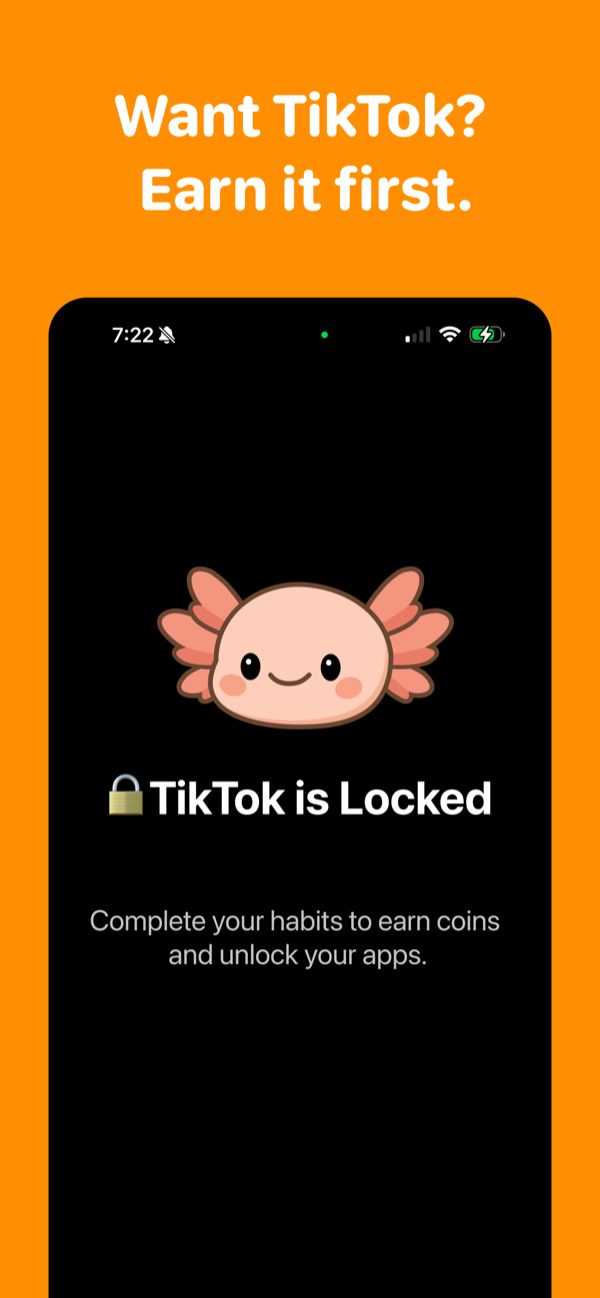
You downloaded a screentime blocker. You set a 30-minute limit on TikTok. For two days, it worked. On day three, you tapped “15 more minutes.” On day four, you uninstalled the app.
If you’re reading this, you already know: the blocker was never the problem. You’ve probably tried two or three. They all start the same. They all end the same.
This post is about why that happens — and why the thing that makes them fail isn’t your willpower. It’s the mechanism.
The willpower tax
Almost every screentime app on the market runs on one of three mechanics:
- Timers. You get N minutes per day. When the timer runs out, the app is locked. You can usually bypass it with one or two taps.
- Friction. The app adds a delay, a breathing exercise, or an “are you sure?” prompt before letting you in.
- Full blocks. The app is hidden or hard-locked during certain hours.
All three rely on the same invisible assumption: that in the moment of temptation, you will choose not to bypass the block. That’s a willpower tax. Every single time you pick up your phone, the app charges you a tiny unit of self-control to get past it.
Willpower is a finite resource. Roy Baumeister’s research on “ego depletion” has been contested, but the lived experience is well-documented: after a long day, a tense meeting, or three hours of deep work, your capacity to resist a default behavior is lower than it was at 9 a.m. The blocker doesn’t know this. It asks for the same unit of willpower at 11 p.m. that it asked for at 9 a.m. — and at 11 p.m., you don’t have it.
This is why the pattern is so consistent. It’s not that you’re weak. It’s that the tool is charging you at the exact moment you have nothing to pay with.
The “just five more minutes” trap
Timer-based blockers make this worse by offering a “just this once” escape hatch. Almost all of them do. The product reason is obvious: if the block is too strict, users uninstall in frustration, and retention tanks. So the design compromise is to let you bypass, gently, with a small friction.
The problem is that the bypass is trained behavior. The first time you tap “15 more minutes,” you feel a little guilty. The fifth time, you don’t even notice you tapped it. Your brain has learned that the block is a speed bump, not a wall — and the speed bump is there to let you through.
Within two weeks, most users stop seeing the blocker at all. It becomes invisible UI. The app is still installed. The stats still look depressing. But the behavior didn’t change.
What a real screentime mechanic has to do
If willpower-at-the-moment-of-temptation is the broken hinge, a working screentime mechanic has to avoid it. It has to make the unlock cost something other than a unit of willpower.
There are three things that have worked historically, in psychology research and in the field:
- Social friction. If other people see the block, shame and accountability do the work willpower can’t. This is how Forest (the tree-growing app) works — your tree dies publicly if you give up.
- Financial stakes. Apps like Beeminder let you lose real money if you break your goal. Very effective, very brutal.
- Action-for-access trades. You do something positive in the real world, and that action earns your phone time. The cost isn’t willpower — it’s a specific action you chose in advance.
The third mechanic is the quiet one. Most people haven’t heard of it. It’s also, in my experience, the one that sticks longest, because unlike the first two it doesn’t punish — it rewards.
Action-for-access: the mechanic behind AxoHabit
This is the approach AxoHabit is built on, and I want to be upfront about the conflict of interest: I build AxoHabit. But I built it because I tried every other screentime app first and watched myself bypass all of them within a week.
Here’s the loop:
- You pick the apps that steal your time. AxoHabit locks them.
- You complete a real-life habit — exercise, reading, drinking water, meditating, anything you can prove with a photo.
- Our AI analyzes the photo to confirm the habit actually happened.
- If it passes, you earn coins. Coins unlock screentime on the blocked apps.
Notice what’s not in this loop: a willpower check at the moment you want to open TikTok. When you want to scroll, you don’t argue with an “are you sure?” prompt. You go do a push-up. Or read ten pages. Or drink a glass of water. The trade is concrete, and it’s designed so that the path to the phone goes through the thing you wanted to do anyway.
This isn’t magic. It’s just a different mechanic. It works because it stops asking for willpower at the moment you don’t have it.
What to try first, even if you don’t use AxoHabit
If you’re reading this and you’re stuck in the timer-blocker loop, here are three things you can try today — no app required:
- Put your phone in another room when you’re not using it. Distance is the cheapest form of friction and it doesn’t charge willpower. Nir Eyal calls this “the pact.”
- Replace the goal of “less phone time” with “more X time.” If you frame the thing in terms of what you gain, not what you give up, you avoid the loss-aversion trap that makes every time check feel like a loss.
- Set one rule, not ten. The fastest way to burn out on any screentime system is to over-engineer it. “No TikTok until I’ve exercised” beats a spreadsheet of app limits.
If those aren’t enough, and you want a system that enforces the trade-off for you — try AxoHabit. It’s free on iOS. It won’t fix your phone habit in a week. But the mechanic underneath it is the one that matched my lived experience of what actually works, and that’s why I built it.
Willpower isn’t the problem. The tools are asking for the wrong thing. Give yourself a tool that asks for an action instead.